
Are we leading the same church?
You can sit around the same leadership table, use the same language, and still carry different assumptions about your church. This conversation guide helps your team get clear on what matters most, across Mission, Values, Purpose, and Strategy.
Most churches have priorities. Few have alignment.
Your mission statement is on the wall. Your values are on the website. But when you ask five leaders to explain them, you get five different answers. That gap between what's stated and what's shared is where churches get stuck.
It doesn't mean something is broken. It means something hasn't been built yet. Shared Direction is the bedrock that everything else sits on: who carries the work, how it moves, how you know it's going, and what comes next. Without alignment here, everything downstream drifts.
- Your team would describe the mission differently if asked separately.
- Values exist on paper but don't shape real decisions.
- There's no shared language for why your church exists in your specific community.
- Ministry strategy feels reactive instead of directional.
- New ideas get added, but nothing gets evaluated against a clear framework.
Similar scores do not mean shared understanding. Two leaders can both rate mission clarity highly while describing two different missions.
Four elements, forty statements, one honest conversation.
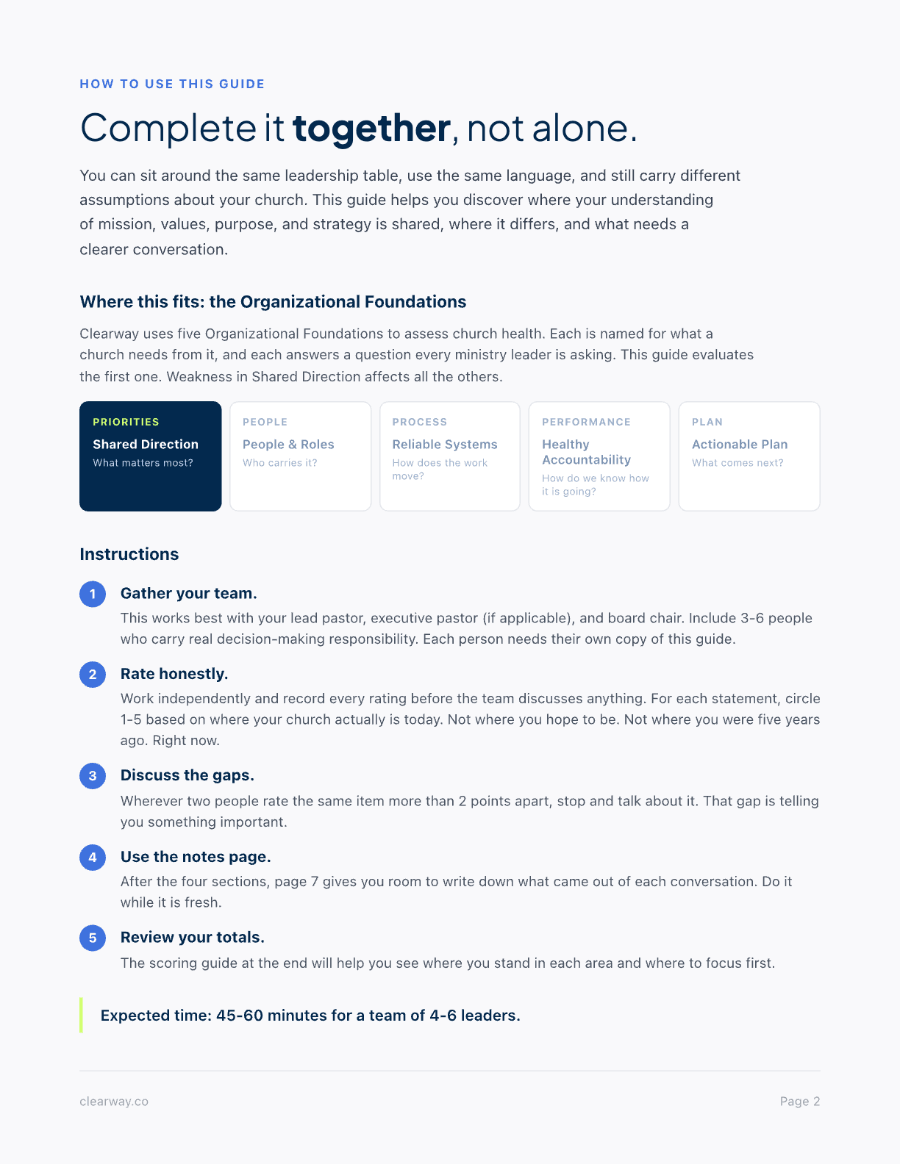
Clearway uses five Organizational Foundations to assess church health. This guide evaluates the first one, Shared Direction, because weakness here affects People & Roles, Reliable Systems, Healthy Accountability, and your Actionable Plan.
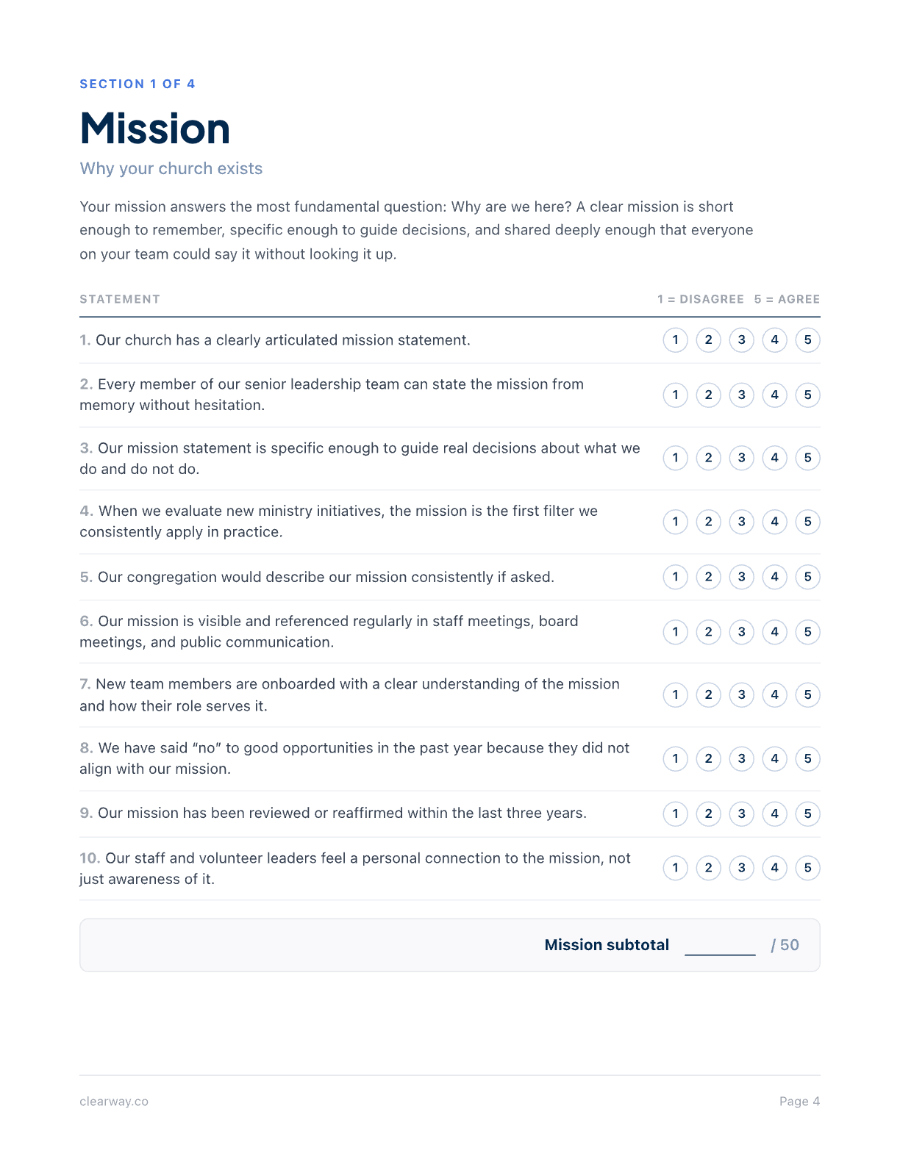
Short enough to remember, specific enough to guide decisions, and shared deeply enough that everyone could say it without looking it up.
Not aspirational posters. The real rules your team lives by. When values are vague, culture happens to you.
Mission is universal, shared by every church. Purpose is yours alone: this church, this place, this time.
Whether upward, inward, outward, and withward are balanced, or whether one direction is quietly carrying everything.
Before anyone rates anything, each leader answers the four questions from memory, in their own words. No documents, no website, no wall. Then you compare.
Twelve pages your team fills in together.
Not another generic church health survey. A focused diagnostic built from real engagements with churches navigating the same challenges.
Four questions answered from memory before any rating begins. Write what you would actually say if a new family asked you over coffee.
Ten per section, scored 1 to 5 by each leader independently. Rate where your church actually is today, not where you hope to be.
Wherever two people rate the same item more than two points apart, stop and talk. That gap is telling you something important.
A notes page for each area, filled in while it is fresh. The most valuable part of this guide is not the scores. It is the discussion it creates.
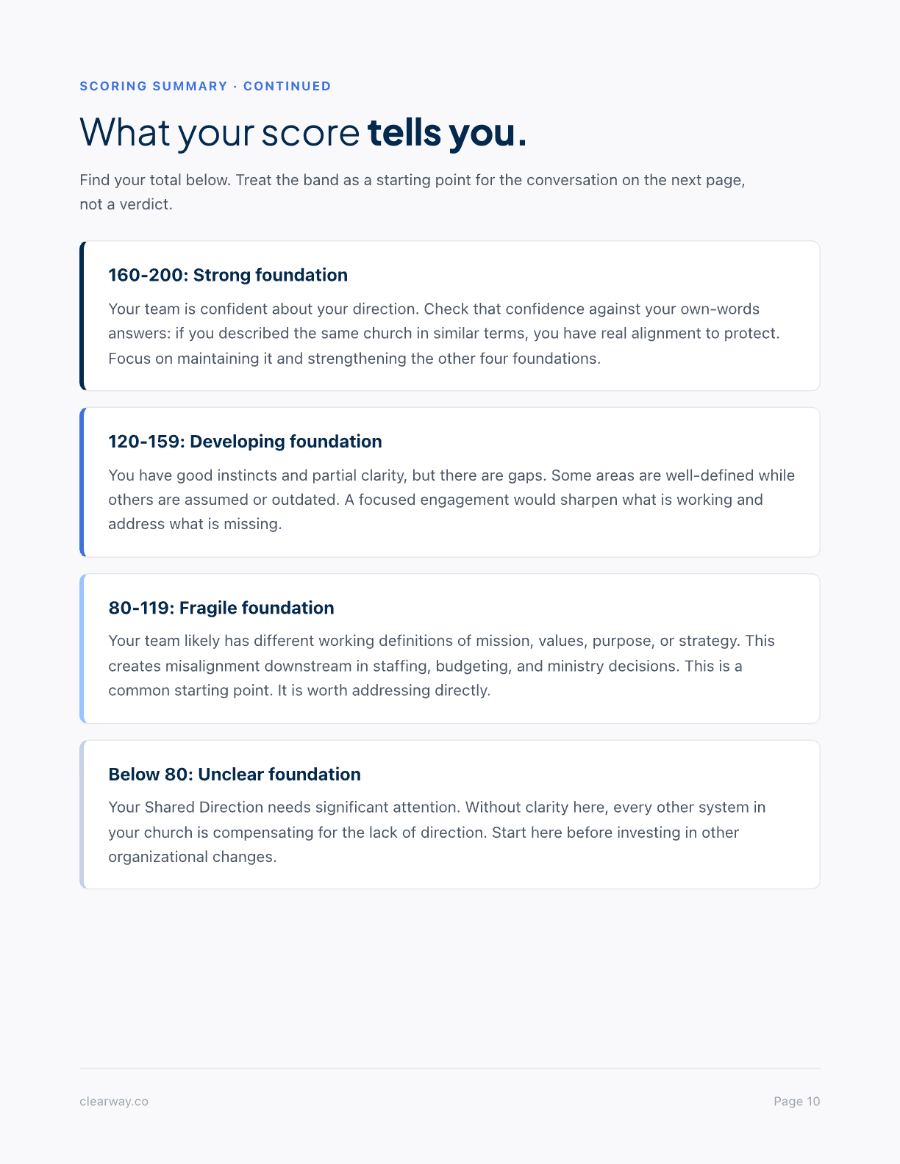
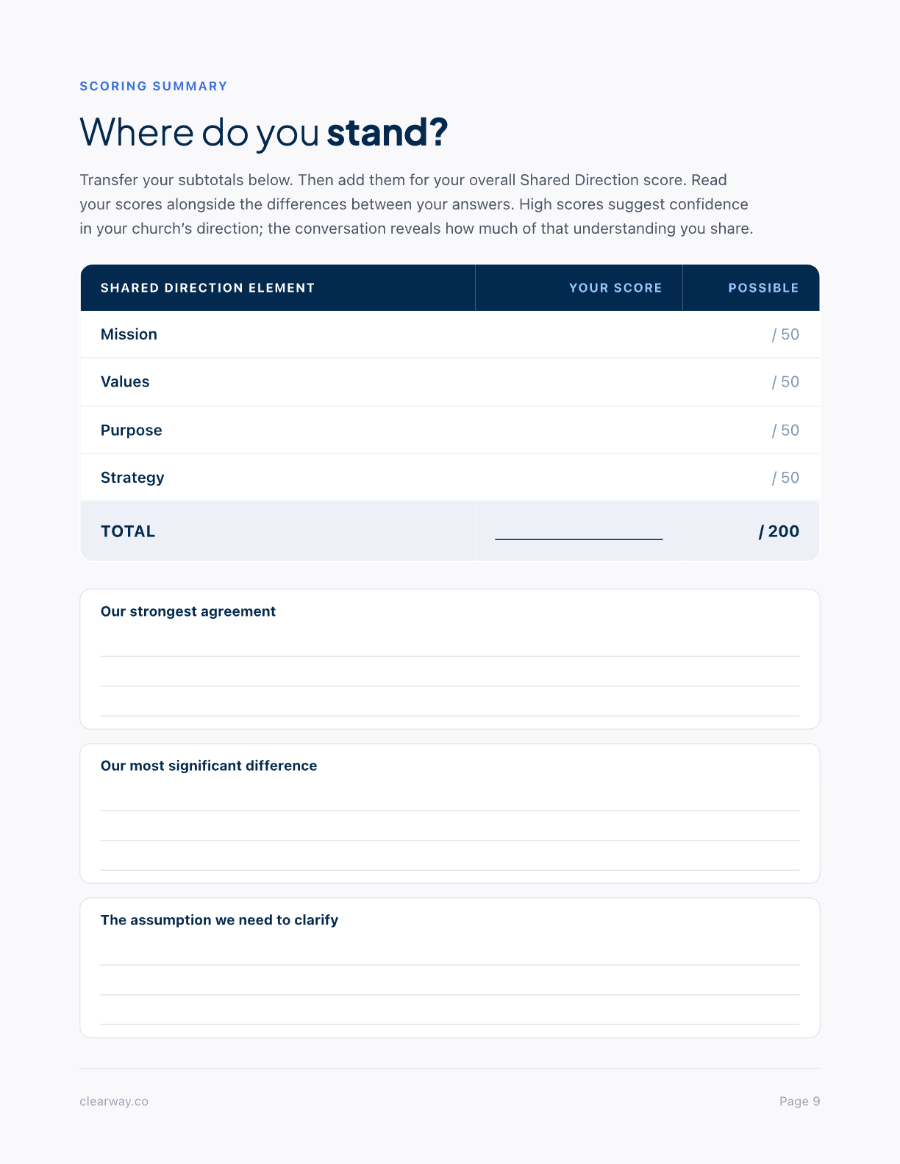
Subtotals out of 50 per element and a total out of 200, plus prompts for your strongest agreement and your most significant difference.
Seven questions to work through as a team, then recommended next steps: name your weakest area, its owner, and the date you will revisit it.
Complete it together, not alone.
Expected time: 45 to 60 minutes for a team of 4 to 6 leaders. The process is simple. The conversations it starts are not. That's the point.
Lead pastor, executive pastor, and board chair, plus 3 to 6 people who carry real decision-making responsibility.
Work independently and record every rating before the team discusses anything. Where your church is right now.
Wherever two people are more than two points apart, stop and talk about it. That is where the real work is.
Write down what came out of each conversation while it is fresh, area by area.
See where you stand in each area and where to focus first. Direction before people. People before systems.

A church came to us convinced their problem was staffing. After working through this evaluation, they realized their team couldn't agree on the mission, let alone align around it. Six months later, with clarity on Mission and Values, the staffing issues resolved themselves. The real problem was never people. It was direction.
Are you leading the same church?
Download the guide free. Work through it with your leadership team. Or, if you want a facilitator for the conversation, book a call with Clearway.
No pitch. No pressure. Just an honest look at where your church is and what the next step might be.
Or book a free conversation