


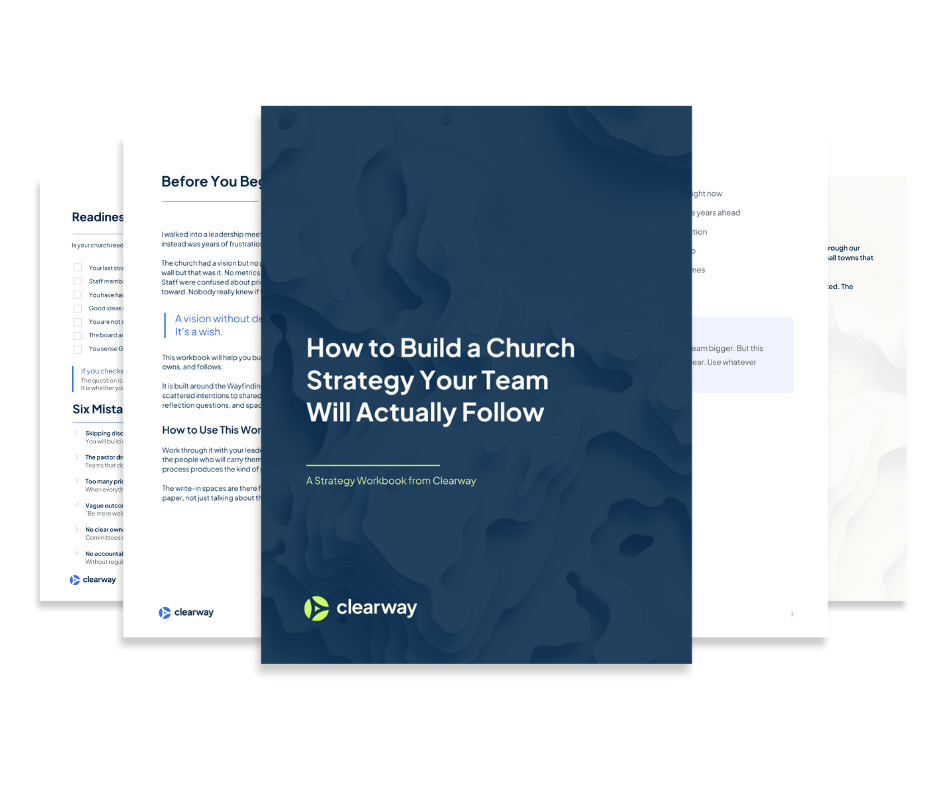
If you've ever finished a planning retreat and wondered why nothing changed six months later, it's probably not because your team lacked commitment. It's because the process you ran produced a document instead of a decision, and there's a real difference between the two. A document summarizes the conversation. A decision ends it, in the best possible way, because everyone in the room knows what you're doing, what you're not doing, and why. That clarity is what strategic planning for churches is actually supposed to produce.
Most processes never get there. They gather the right people, fill a whiteboard, write up the notes, and call it a plan. Six months later the document is somewhere in a shared drive and the team is back to making decisions by whoever speaks loudest. The problem isn't your team's follow-through. The problem is that the process never produced a shared decision in the first place. What follows is a different kind of process.
Planning produces a decision not a document
There's a difference between a planning process that ends with a written summary and one that ends with a shared decision, and most churches never experience the second kind. A summary describes what was discussed. A decision closes something: the team knows what they're doing, what they're not doing, and why. That closure is what makes change possible.
You can finish a planning retreat with pages of good ideas and a general sense that things went well, and then nothing moves. The team is committed to the mission, but the strategic process never asked them to commit to anything specific. Nobody was told what to stop, nobody was given ownership of what to start, and the document went into a folder and the team went back to the work they were already doing.
"Strategic planning for churches is about discerning the direction God is calling you toward.
That's the gap Wayfinding is built to close. When pastors would describe what they were experiencing before they called me, the pattern was consistent: staff confusion, decisions made by whoever spoke loudest, people moving in different directions without realizing it. And underneath all of it, a leadership team that had never actually decided together where they were going and why. Wayfinding was built for exactly that situation.
Unlike a corporate SWOT exercise, Wayfinding begins with prayer and discernment, because building a church strategic plan isn't about launching new products or increasing revenue. It's about determining how to invest your most important resources toward the most important work God is calling you to pursue. The process moves a leadership team from scattered ideas to a focused strategy the whole team believes in, and churches finish it with a clear 3-year Vision holding four to six strategic priorities, each with goals, owners, and metrics. That's a decision. Everything before it's preparation.
Discovery comes before dreaming for a reason
The most common shortcut in church planning is skipping straight to vision before anyone has honestly assessed where things actually stand. Leadership gets excited about what could be, and the planning process becomes a reflection of whoever speaks loudest rather than an honest picture of the church's actual health and hunger.
Discovery is the foundation, because the picture of the future has to be built on what is real, not on what leadership hopes is true.
In Wayfinding, the Discover stage involves conversations with staff, board, and ministry leaders to learn what the church is celebrating and where things stand. That means qualitative conversations with the people closest to the work, and almost always a quantitative survey alongside them, because having data matters. Impressions and feelings can point you somewhere, but numbers tell you whether your impressions are actually shared across the congregation or just held by the people in the room with you.
There are two ways this stage gets skipped or mishandled. The first is that decisions get made by too small a group, usually the senior pastor and one or two trusted voices, and the rest of the team inherits a direction they had no part in forming. The second is the opposite: so many people give input that no decision can be made, because every voice carries equal weight and the process collapses under its own breadth. Discovery done well threads that needle. It brings in the right people at the right time, gathers honest input, and gives leadership something real to build from.
It's worth knowing that staff anxiety during vision work is normal at this stage. People wonder what the questions mean for their role. Good discovery processes name that honestly rather than pretending the conversations are purely logistical.
Dreaming and discerning are different
Most planning processes collapse these two conversations into one, and that's where the process breaks down. The Dream stage is supposed to open the field wide, asking what might be possible without the constraint of current capacity. The Five Lenses exercise builds the 10-Year Future across five dimensions: Congregation, Community, Leadership, Operations, and Learning. The Four Helpful Lists run alongside the Five Lenses, surfacing what's right, what's wrong, what's missing, and what's confusing. Together they give the team permission to think bigger than next year's budget, and that openness is genuinely necessary. You can't build a compelling future by only looking at what's already in front of you.
But dreaming and deciding aren't the same conversation, and treating them as if they're produces a long list of exciting ideas with no shared sense of what actually matters most.
"Discernment is the work of saying no to good things so you can say yes to the right ones.
The Discern stage is where that harder work happens. It's facilitated conversations that build a shared sense of what is essential and what's a distraction, and it requires its own space because the team needs to move from possibility to priority without feeling like the dream just got smaller. The question the Discern stage is trying to answer is the one that exposes every real constraint: given what you have, what you believe, and where you're going, what are you actually going to do, and what do you have genuine capacity to carry?
The Decide stage is where that answer becomes a commitment, determining what the church will do and what it won't do. That's the moment the process earns its value. Without it, you leave with inspiration. With it, you leave with direction.
Why all three planning horizons matter
When churches plan, they tend to collapse everything into one horizon, usually the next twelve months, and the result is a team that's always reacting to what's immediate and never building toward anything larger. A to-do list for the next year isn't a strategy, even when it's organized and well-presented.
Wayfinding builds three distinct horizons because each one does a different job. The 10-year Future, constructed through the Five Lenses exercise across five dimensions (Congregation, Community, Leadership, Operations, and Learning), gives the team permission to think beyond their current constraints. It's a picture of what you're building toward, and it exists to give the work of the next three years a direction worth moving in.
The 3-year Vision is where the church's actual vision lives. It holds four to six Vision Outcomes, which are the church's strategic priorities, each specific, measurable, and time-bound. They're the specific results the church has committed to producing, with owners and metrics attached, which is what makes them a decision rather than a wish list. That's what makes them a decision rather than a wish list.
The 1-year Outlook translates the 3-year Vision into the specific contribution the team will make this year, connecting daily work to a longer arc that actually means something.
The reason all three matter is that they nest. Weekly tasks connect to seasonal goals, seasonal goals connect to annual priorities, and annual priorities connect to the 3-year Vision and the 10-year Future. When that chain is intact, a staff member can look at their work on a Tuesday morning and trace a line from what they're doing to where the church is going. When it isn't, you have a team working hard in different directions and wondering why momentum is so hard to build.
The real work begins after the retreat
The planning retreat is where direction gets decided. What happens in the following weeks is where that direction either takes hold or quietly fades back into the familiar patterns of whatever the team was already doing.
Communication is the first priority after Wayfinding ends. The people who gave input during Discovery are waiting to hear what was decided, and leaving them without an answer is one of the fastest ways to lose the goodwill the process built. We always close Wayfinding by building a cascading communication strategy, starting with elders, key lay leaders, and significant donors, and working outward from there. People who were asked what they thought deserve to hear what came of it.
Within 30 days of the process ending, Clearway delivers a written report of everything heard and begins follow-up conversations to help the church think through how that rollout actually happens. Closing the gap between vision and execution starts here, not at the retreat.
After communication, the work becomes seasonal. Every staff goal gets connected to a specific Vision Outcome so the chain from daily work to three-year direction stays intact. Each goal needs to be owned by a person, not a committee, with a clear result and a defined end date. They're what make accountability possible without it feeling like surveillance, which is why ownership, a clear result, and a defined end date are built into every goal.
Seasonal Goal Reviews happen every four months, in the seasons of September to December, January to April, and May to August. They extend the usual 60-minute Monthly 1:1 to 90 minutes and move through a Look Back, Look Up, Look Forward structure: reviewing what happened, reconnecting with the Vision Outcomes, and agreeing on the next contribution.
CORE is the dashboard where all of this lives together, Vision Outcomes, goals, projects, milestones, and tasks, so ownership is visible and the whole team can see whether the church is actually moving toward what it said mattered.
What the four to six month process looks like
One reason churches avoid strategic planning is that they can't picture what it actually involves, so it feels like an open-ended commitment to a process that might never land anywhere. Wayfinding runs four to six months from beginning to end, moves through five named stages in sequence, and ends with a specific set of deliverables the team can hold and use. That shape is what lets a leadership team decide whether they have the capacity to run it themselves or whether they need someone to hold the process for them.
The five stages are Discover, Dream, Discern, Decide, and Define, in that order, and the sequence matters. Each stage builds on what the one before it produced. Clearway's Wayfinding engagement is facilitated by me from start to finish, which means the senior pastor isn't also trying to manage the room while the team is doing the hardest thinking they'll do together.
At minimum the senior pastor, key staff, and board representation take part. Those aren't optional groups. The process produces a shared decision, and the people who will be accountable for carrying it out need to be in the room when it's made.
Deliverables include a one-and-a-half-day planning retreat, the Five Lenses visioning work, a written strategic plan delivered as a digital document, the Vision Matrix, a custom action plan, and access to the CORE dashboard where seasonal goals are tracked through the year.
Pricing depends on church size, complexity, and scope of engagement and isn't published, because the right conversation starts with your situation, not a number on a page.
- A planning process that ends with a document instead of a shared decision won't change how your team works. The goal is closure: everyone knows what you're doing, what you're not doing, and why.
- Discovery has to come before dreaming. Honest input from staff, board, and congregation gives the vision something real to stand on. Skipping it means the plan reflects whoever speaks loudest.
- Dreaming and discerning are separate conversations that need separate space. Opening the field wide is necessary. So is the harder work of deciding what you actually have capacity to carry.
- The planning retreat isn't the finish line. Communication, seasonal goals connected to Vision Outcomes, and a 90-minute Seasonal Goal Review every four months are what make the direction stick.
Strategic planning for churches isn't about launching new products or increasing revenue. It's about determining how to invest your most important resources toward the most important work God is calling you to pursue. That's a different kind of process, and it deserves a different kind of conversation. This week, write down the one question your leadership team can't currently answer together: where are we going and why? If you can't answer it in a sentence everyone agrees on, that's the gap Wayfinding is built to close. Book a call with me to find out whether the process fits your church's situation.