

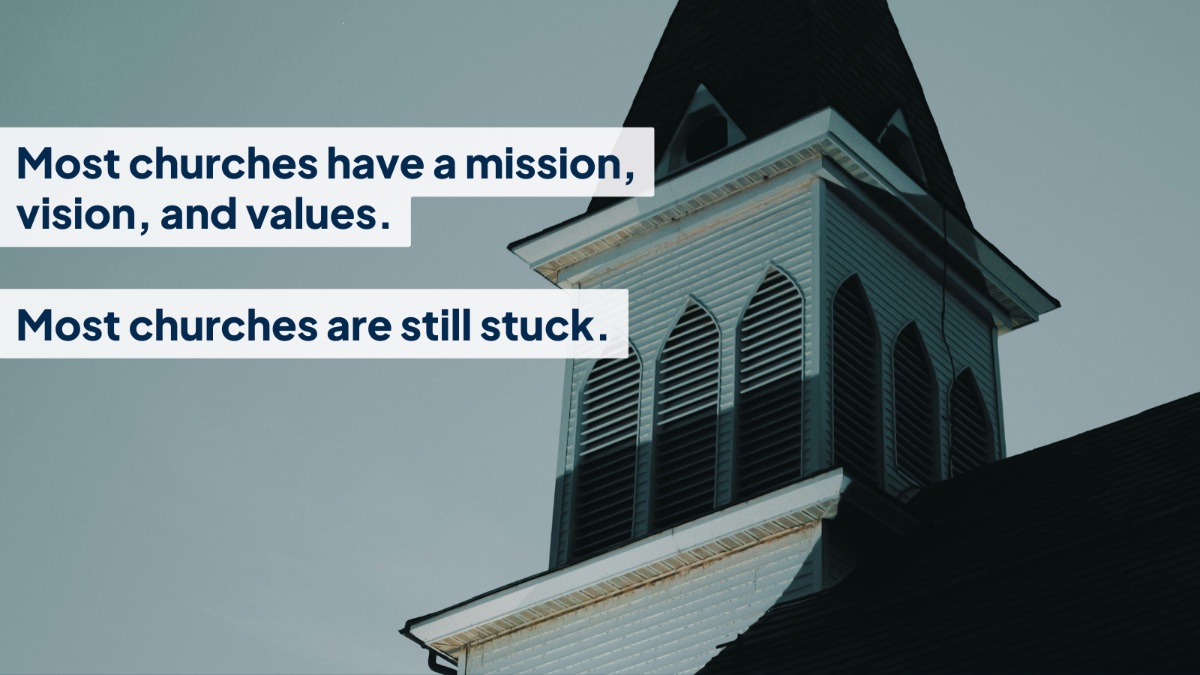

If you lead a church of any size, you've probably been through the exercise. Maybe more than once.
Someone suggests a retreat. You gather your leadership team in a room with whiteboards and sticky notes. You talk about who you are, where you're going, and what you believe. You wordsmith statements until everyone is tired. You print the results on banners, put them on the website, maybe even read them from the stage.
And then six months later, nothing has changed.
The mission statement sits on a wall. The vision statement lives in a drawer. The values sound nice but don't seem to shape any actual decisions. And the same frustrations that drove you to the retreat in the first place are still showing up on Monday morning.
You are not alone in this. And the problem might not be your execution. It might be the framework itself.
The Problem with "Mission, Vision, Values"
The standard Mission, Vision, Values (MVV) framework has become so ubiquitous in church leadership that most pastors don't think to question it. It's the default. Every leadership book references it. Every church planting network teaches it. It feels like the responsible thing to do.
But here is what we've seen after years of working with churches: the MVV framework, as most churches use it, creates the illusion of clarity without producing actual alignment.
There are a few reasons for this.
Mission and vision blur together. Ask ten church leaders to define the difference between a mission statement and a vision statement, and you'll get ten different answers. Some say mission is what you do and vision is where you're going. Others flip it. Some combine them into one statement. The confusion isn't a failure of intelligence. It's a signal that the categories themselves aren't clear enough to be useful.
Values become aspirational wallpaper. Most church value statements are lists of words that any church would claim. Excellence. Community. Authenticity. Generosity. They sound right, but they don't distinguish your church from the one across town. When values are generic enough to apply to everyone, they guide no one. They certainly don't help you make a hard decision on a Tuesday afternoon when two good options are competing for the same resources.
The framework skips what matters most. MVV gives you statements about identity and direction, but it doesn't answer the question that actually keeps church leaders awake at night: How do we make decisions when things get complicated? It gives you a banner for the lobby. It doesn't give you a filter for the leadership meeting.
This isn't a small gap. It's the gap. And it's why so many churches complete the MVV exercise feeling inspired, then return to the same patterns of drift, confusion, and misalignment within a few months.
What If There's a Better Framework?
At Clearway, we work with churches to build what we call Priorities, the foundational clarity that everything else in your organization depends on. Priorities are the keel of the boat. They're below the waterline, invisible to most people, but without them the whole thing capsizes under pressure.
Instead of Mission, Vision, Values, we help churches work through four elements that are more precise, more theological, and more practically useful:
Mission. Values. Purpose. Strategy.
Each one does specific work that the MVV framework either overlooks or combines into something too vague to act on. And each one has roots in Scripture that go far deeper than a wall banner. Let's walk through them.
Mission: The One Thing Every Church Shares
Here is something most mission statement exercises get wrong from the start: they treat mission as something each church needs to invent.
You don't. The mission of the church has already been given.
Before the ascension of Jesus, we have the clearest organizational mandate in history. Not a suggestion. Not a guiding principle. A commission:
"All authority in heaven and on earth has been given to me. Therefore go and make disciples of all nations, baptizing them in the name of the Father and of the Son and of the Holy Spirit, and teaching them to obey everything I have commanded you. And surely I am with you always, to the very end of the age." (Matthew 28:18-20)
That's the mission. It applies to every church in every city in every era. But Jesus didn't give us the Great Commission in isolation. He also gave us the lens through which we pursue it:
"Love the Lord your God with all your heart and with all your soul and with all your mind. This is the first and greatest commandment. And the second is like it: Love your neighbor as yourself. All the Law and the Prophets hang on these two commandments." (Matthew 22:37-40)
The Great Commission tells you what the church exists to do. The Great Commandment tells you how. A mission statement that emphasizes disciple-making without love becomes a production line. A mission statement that emphasizes love without disciple-making becomes a social club. Both miss the point. The church's mission integrates both: we love God, we love people, and we make disciples. These are not three separate activities. They are one integrated calling.
This might feel like it removes creativity from the process. It actually does the opposite. When you stop trying to craft a unique mission statement and instead anchor yourself to the mission Jesus already gave, you free up enormous energy for the work that actually needs to be unique to your church, which we'll get to in a moment.
Your mission statement should integrate both the Great Commission and the Great Commandment. Not one or the other. Not a clever repackaging that obscures the biblical roots. A clear, honest articulation of what the church exists to do.
This grounds everything that follows. And it keeps the conversation honest. You're not inventing your reason for being. You're receiving it.
Values: What You Care About More Than Others Do
This is where most churches go sideways. Values, as typically practiced, become a list of words that sound important but don't actually function as decision-making tools.
Here is the test: if another church in your city could put the same values on their wall and no one would notice the difference, your values aren't doing their job.
Healthy values answer a very specific question: What does this church care about more than similar churches care about it?
Every church cares about prayer. Every church cares about community. Those are baseline commitments, not distinguishing values. Your values should reflect the things you are willing to prioritize even when it costs you something. They should be specific enough that someone could look at how you spend your time, your money, and your energy, and identify those values without being told what they are.
Scripture models this clearly. When Paul addressed different churches, he didn't treat them as interchangeable. He affirmed what was distinctly true about each one. To the Thessalonians he wrote, "Your faith in God has become known everywhere" (1 Thessalonians 1:8). To the Philippians, "Not one church shared with me in the matter of giving and receiving, except you only" (Philippians 4:15). The Thessalonians were known for contagious faith. The Philippians were known for radical generosity. These weren't accidents. They were distinguishing values lived out so consistently that other churches noticed.
We call this the difference between stated values and operative values. Stated values are what you say matters. Operative values are what your calendar, your budget, and your staffing decisions reveal. In a healthy church, those two lists match, or at least we're being honest about where the gap exists and how we'd like to move toward greater expressions of what we say we value.
Values that live on a website but don't show up in your hiring decisions, your budget allocations, and your hardest leadership conversations are not values. They are aspirations. And aspirations without action create cynicism.
The work of clarifying values isn't a brainstorming exercise. It's a discernment exercise. You're not choosing aspirational words. You're naming what is already true about who God has made your church to be, and then deciding whether you're willing to own it and lean into it.
Purpose: Your Unique Kingdom Assignment
This is the piece that the standard MVV framework almost always leaves out, or tries to shove into the vision statement where it gets lost.
Purpose answers the question: What has God uniquely called this church to do, in this place, at this time?
Not what you could do. Not what the church down the road is doing. Not what's trendy in the broader church world. What has God specifically assigned to you?
Every church shares the same mission. But every church has a different purpose. Scripture makes this remarkably clear. The New Testament churches were not cookie-cutter expressions of the same model. They were distinct congregations with distinct callings, operating in distinct contexts, all under the same Great Commission.
The church in Antioch became the first great sending church. When the Holy Spirit said, "Set apart for me Barnabas and Saul for the work to which I have called them" (Acts 13:2), it was Antioch that fasted, prayed, laid hands on them, and sent them out. Their purpose was multiplication, launching leaders and planting churches across the known world.
The church in Thessalonica had a different assignment. Paul described them as "a model to all the believers in Macedonia and Achaia" (1 Thessalonians 1:7). Their faithfulness under persecution became an example that echoed across the region. Their purpose was to embody resilient faith so visibly that other churches took notice.
The church in Philippi was distinctly generous. Paul told them, "In the early days of your acquaintance with the gospel, when I set out from Macedonia, not one church shared with me in the matter of giving and receiving, except you only" (Philippians 4:15). They funded the mission. Their purpose was partnership through resource.
And the church in Ephesus was called to doctrinal clarity. Paul told Timothy to stay in Ephesus specifically "so that you may command certain people not to teach false doctrines" (1 Timothy 1:3). In a city saturated with competing spiritual claims, their purpose was to hold the line on truth.
Same mission. Same gospel. Different purposes. And each church discovered its purpose not by copying another church's playbook, but by discerning what God was doing in their specific context.
When purpose is clear, it becomes the most powerful filter you have. It helps you say yes to the right things and no to the good things that aren't yours to carry. It resolves arguments about programming and resource allocation. It gives your congregation a story they can tell about why this church exists, here, now.
When purpose is unclear, you end up trying to do everything. And churches that try to do everything end up doing nothing with excellence and burning out their leaders in the process.
Strategy: The Discipleship Pathway That Moves People
Strategy is not a plan. A plan is something you execute on a timeline. Strategy is the ongoing pattern by which your church makes and matures disciples. It answers the question: How do we actually move people toward spiritual maturity?
The earliest picture of church strategy is Acts 2. Luke doesn't give us a mission statement or a strategic plan. He gives us a snapshot of what the first church actually did:
"They devoted themselves to the apostles' teaching and to fellowship, to the breaking of bread and to prayer. Everyone was filled with awe at the many wonders and signs performed by the apostles. All the believers were together and had everything in common. They sold property and possessions to give to anyone who had need. Every day they continued to meet together in the temple courts. They broke bread in their homes and ate together with glad and sincere hearts, praising God and enjoying the favor of all the people. And the Lord added to their number daily those who were being saved." (Acts 2:42-47)
Look at what's there. Teaching and prayer: connection with God. Fellowship and breaking bread together: doing life in community. Selling possessions to meet needs: reaching outward. Meeting in the temple and in homes: structured and organic rhythms working together. This passage isn't a program outline. It's a picture of integrated spiritual formation happening across multiple dimensions simultaneously.
We find that a four-directional framework drawn from this passage gives churches the clearest and most biblical lens for strategy.
Upward: How do you help people connect with God? This includes worship, prayer, and spiritual formation. In Acts 2, this shows up as devotion to prayer, the breaking of bread, and praising God.
Inward: How do you help people grow in their faith? This includes teaching, small groups, and personal discipleship. In Acts 2, this is devotion to the apostles' teaching and the awe that filled the community.
Outward: How do you help people reach their community? This includes evangelism, service, and justice. In Acts 2, this is selling possessions to meet needs and enjoying the favor of all the people, a community so compelling that outsiders wanted in.
Withward: How do you help people do life together? This includes fellowship, care, and authentic community. In Acts 2, this is having everything in common, meeting in homes, and eating together with glad and sincere hearts.
A healthy strategy addresses all four directions. Most churches are strong in one or two and weak in the others. Knowing where you're strong and where you're weak isn't a failure. It's the beginning of honest assessment that can lead to real growth in the areas that need attention.
Strategy also connects directly to your purpose. If your unique kingdom assignment is reaching the arts community, your outward strategy will look different than a church called to refugee resettlement. Purpose shapes strategy. Strategy without purpose is just activity.
Why This Order Matters
Mission, Values, Purpose, Strategy. The order is intentional.
You start with what's shared and given (Mission). Then you clarify what makes you distinct (Values). Then you discern what God has specifically called you to (Purpose). Then you build the pathway that fulfills that calling (Strategy).
Each element depends on the one before it. You can't define meaningful values without first grounding yourself in mission. You can't discern purpose without knowing what you value. You can't build strategy without clarity on purpose.
Paul understood this progression. When he wrote to the Corinthians about the body of Christ, he was making the same point at an individual level: "The eye cannot say to the hand, 'I don't need you!' And the head cannot say to the feet, 'I don't need you!'" (1 Corinthians 12:21). Each member has a shared identity (the body), distinct characteristics (different parts), a specific function (unique purpose), and a way of operating (strategy for contribution). What's true of individuals within a church is also true of churches within the kingdom. Every church is part of the same body. Every church has a different role to play.
When churches skip steps or start in the wrong place, they end up with strategy disconnected from calling, values disconnected from mission, and purpose that changes every time a new trend shows up.
This is what we mean by the upstream principle: when something isn't working downstream, the solution almost always lives upstream. If your strategy feels scattered, the fix isn't a better plan. The fix is clearer purpose. If your purpose feels vague, the fix isn't more dreaming. The fix is honest work on your values. If your values don't guide decisions, the fix is returning to your mission and asking whether it's actually grounded in what Jesus asked the church to be.
Where to Start
If you're reading this and recognizing some of these patterns in your own church, here are a few honest starting points.
Audit what you have. Pull out your current mission statement, vision statement, and values. Read them with fresh eyes. Could another church use the same words? Do they actually shape decisions? When was the last time you referenced them in a leadership meeting?
Test your mission against Scripture. Does your mission statement reflect both the Great Commission and the Great Commandment? Does it point to disciple-making and love, or has it drifted into something vaguer? If your mission statement doesn't connect clearly to Matthew 28 and Matthew 22, it may need to be simplified, not expanded.
Ask the operative values question. If a new staff member watched your calendar, your budget, and your meeting agendas for 30 days without seeing your stated values, what would they conclude your church actually cares about? The gap between that answer and your wall art is where the real work begins.
Look for your kingdom assignment. What has God been doing through your church that you might not have named yet? What do people in your community come to you for? What energizes your congregation most? Like the churches in the New Testament, your purpose isn't something you invent. It's something you discover by paying attention to where God is already at work.
Resist the urge to start with strategy. If you're feeling stuck, the temptation is to build a new plan. But if your priorities aren't clear, no plan will save you. Start upstream. Get the foundations right, and strategy becomes much simpler.
Do this together. Priorities are not something a senior pastor should craft alone. The healthiest churches we work with bring their core leadership team into this process. Shared understanding creates shared ownership. And shared ownership is the only way these things move from paper to practice.