

Executive Pastor Coaching: What It Is and Why It's Different
Most coaching conversations in the church world are designed for lead pastors. The content, the frameworks, the advice. It is all built around preaching, vision casting, and spiritual leadership. And that makes sense. Lead pastors carry a unique burden.
But executive pastors carry a different one. And almost nobody is coaching them for it.
If you are an executive pastor, you know the feeling. You are the person who makes the church actually work. You manage the staff, the budget, the operations, the board logistics, and the hundred small decisions that keep everything running. You are the bridge between the lead pastor's vision and the team's execution. And most days, you feel like you are doing it alone.
Executive pastor coaching exists for exactly this reality. It is not generic leadership coaching repackaged for ministry. It is coaching designed for the specific challenges of the XP role: the operational complexity, the relational dynamics, the tension between leading and serving, and the loneliness of a position that few people fully understand.
Why Executive Pastors Need Specialized Coaching
The executive pastor role is one of the most complex in church leadership. You report to the lead pastor, but you also lead the staff. You are responsible for operations, but you are expected to be pastoral. You make hard decisions about budgets and personnel, but you do it in a context where relationships are paramount and every conversation carries spiritual weight.
This creates tensions that generic coaching does not address:
The authority gap. You have significant responsibility but often unclear authority. The lead pastor expects you to lead the team, but decisions still need his approval. Staff members are not sure whether you speak for the pastor or for yourself. You spend energy navigating dynamics that a clear organizational structure would resolve, but church culture makes those structures feel too corporate.
The translation burden. Your job is to take the lead pastor's vision and turn it into operational reality. But vision is often expressed in broad, aspirational terms, and operations require specificity. You are constantly translating between two languages: the language of inspiration and the language of execution. When the translation is off, both sides are frustrated.
The relational complexity. In a corporate environment, an operations leader can make decisions based primarily on effectiveness. In a church, every decision has a relational dimension. Letting go of an underperforming staff member means losing a friend. Restructuring a ministry means disrupting someone's calling. You carry the weight of both the organizational and the relational, and you rarely get to choose one over the other.
The invisibility of the role. Lead pastors are visible. They preach. They are the face of the church. Executive pastors work behind the scenes. When things go well, the lead pastor gets the credit. When things go wrong, the XP gets the questions. This is not a complaint. It is the nature of the role. But it creates a particular kind of loneliness that requires intentional support.
Moses and Aaron modeled something close to this dynamic. Moses was the visible leader, the one who spoke to the people and carried the vision. Aaron was the operational partner, the one who managed logistics and navigated the practical realities. Exodus 4:14-16 describes how God established this partnership: "He will speak to the people for you, and it will be as if he were your mouth and as if you were God to him." The roles were distinct but interdependent. Neither could function well without the other. That same interdependence defines the lead pastor and executive pastor relationship today.
What Executive Pastor Coaching Covers
Effective coaching for executive pastors addresses the specific demands of the role, not just general leadership principles.
Operational leadership in a ministry context. How do you build systems that serve the mission without making the church feel like a corporation? How do you bring efficiency to environments that value relationship over speed? How do you manage budgets, facilities, and logistics while maintaining a pastoral heart? These are not generic management questions. They require someone who understands the unique pressures of church operations.
Relationship with the lead pastor. This is often the most important and most difficult relationship in the church. Coaching helps you navigate disagreements constructively, communicate effectively about workload and expectations, and build the kind of trust that allows both leaders to operate in their strengths. When this relationship is healthy, the whole church benefits. When it is strained, everything suffers.
Staff leadership and development. You are often the person who hires, manages, and sometimes lets go of staff members. Coaching helps you develop skills in giving honest feedback, building accountability without micromanaging, and creating a team culture where people grow. It also helps you navigate the particular challenge of leading people in a context where spiritual and professional expectations intersect.
Personal sustainability. Executive pastors burn out at high rates. The role demands constant availability, emotional labor, and the ability to absorb stress from multiple directions. Coaching helps you identify early warning signs, set boundaries that are realistic for ministry, and build practices that sustain you for the long haul.
Paul's instruction to Timothy is relevant here. In 1 Timothy 4:16, he wrote, "Watch your life and doctrine closely. Persevere in them, because if you do, you will save both yourself and your hearers." The "watch your life" piece matters. Executive pastors who focus entirely on the organization and neglect their own health eventually have nothing left to give. Coaching creates space to pay attention to what is happening inside you, not just around you.
Strategic thinking and decision-making. How do you evaluate competing priorities? When do you push back on new ideas and when do you figure out how to make them work? How do you help the lead pastor see operational realities without being perceived as negative or resistant? Coaching develops the strategic muscles that executive pastors need but rarely have time to exercise.
How Executive Pastor Coaching Differs from Other Coaching
If you have explored coaching before, you may have encountered leadership coaching, business coaching, or pastoral counseling. Executive pastor coaching overlaps with each of these but is distinct from all of them.
It is not leadership coaching for lead pastors. Lead pastor coaching focuses on vision, preaching, spiritual authority, and congregational leadership. Executive pastor coaching focuses on operations, staff leadership, organizational systems, and the partner dynamic with the lead pastor. The skill sets overlap but the daily realities are different.
It is not business coaching applied to church. Business coaching brings frameworks from corporate environments. Some of those frameworks are useful in churches. Many are not. A business coach may advise you to "hold people accountable to metrics," but in a church, accountability looks different. A business coach may push you to "streamline decision-making," but in a church, some decisions require communal discernment. Executive pastor coaching understands the difference.
It is not pastoral counseling. Counseling addresses emotional and psychological health. Coaching addresses leadership effectiveness. Both matter. But coaching is forward-looking and action-oriented. It helps you think through real scenarios, make better decisions, and develop skills you can apply immediately.
It is not mentoring from a more experienced pastor. Mentoring is valuable, but it is typically advice-driven: "Here is what I did in your situation." Coaching is question-driven: "What are you seeing? What options do you have? What would it take to move forward?" A good coach helps you think more clearly, not just follow someone else's playbook.
What to Look for in an Executive Pastor Coach
Finding the right coach matters more than finding any coach. Here is what to prioritize:
Experience in the XP role. Your coach should have firsthand experience as an executive pastor or in a similar operational leadership role in a church. Book knowledge about the role is not sufficient. You need someone who has felt the weight, navigated the politics, and understands what it costs to do this work.
Understanding of church governance. Churches are not corporations. Decision-making involves boards, congregational votes, denominational structures, and spiritual discernment processes that corporate coaches do not understand. Your coach should know how to navigate these dynamics, not just work around them.
Willingness to challenge you. A coach who only affirms you is not worth the investment. You need someone who will ask the hard questions: Are you avoiding a conversation you need to have? Are you carrying work that should be delegated? Is your relationship with the lead pastor healthy or just functional? Proverbs 27:6 applies directly: "Wounds from a friend can be trusted, but an enemy multiplies kisses." A good coach is honest enough to wound when necessary and caring enough to do it well.
Confidentiality and trust. You need a space where you can be completely honest about what you are experiencing. That means your coach cannot be someone who reports to your board, has a relationship with your lead pastor that creates a conflict, or works within your denominational structure in a way that compromises your privacy. Confidentiality is the foundation of effective coaching.
What a Typical Coaching Engagement Looks Like
Executive pastor coaching typically follows a rhythm:
Monthly sessions. Most coaches meet with clients once or twice a month for 60 to 90 minutes. These sessions are structured around your current challenges, goals, and development areas. You bring the real situations you are facing, and the coach helps you think through them more clearly.
Async support between sessions. Many coaches offer email or message access between sessions for quick questions, real-time challenges, or situations that cannot wait for the next meeting. This makes coaching practical, not just theoretical.
Assessment and baseline. Some coaches begin with a leadership assessment or 360 review to establish a baseline. This gives you data about how your leadership is landing on the people around you and helps focus the coaching on the areas that matter most.
Regular review of progress. Every few months, you and your coach review what has changed. Are you making better decisions? Are your relationships with the lead pastor and staff healthier? Are you more sustainable in your pace? Coaching should produce measurable change, even if the measures are observational rather than numerical.
The Cost of Not Being Coached
Executive pastors who go without coaching often experience a predictable pattern. They manage well for a season, absorbing stress and solving problems. Gradually, the weight accumulates. Decisions get harder. Relationships get more strained. The work that once energized them begins to exhaust them. And eventually, they either burn out, disengage, or leave.
This pattern is preventable. Not by working less, though that might help. But by having a thinking partner who helps you process what you are carrying, see your blind spots, and make decisions with greater clarity.
The churches that retain their executive pastors for the long term are the ones that invest in their development, not just their performance.
Your Next Step
If you are an executive pastor who feels the weight of the role but lacks a space to process it honestly, coaching gives you that space. It is not a luxury. It is a leadership practice that keeps you effective, healthy, and engaged in the work you were called to do.
Start by asking yourself one question: Who do I talk to when the work gets hard? If the answer is "no one," that is the clearest sign you need a coach.
Explore coaching for church leaders →
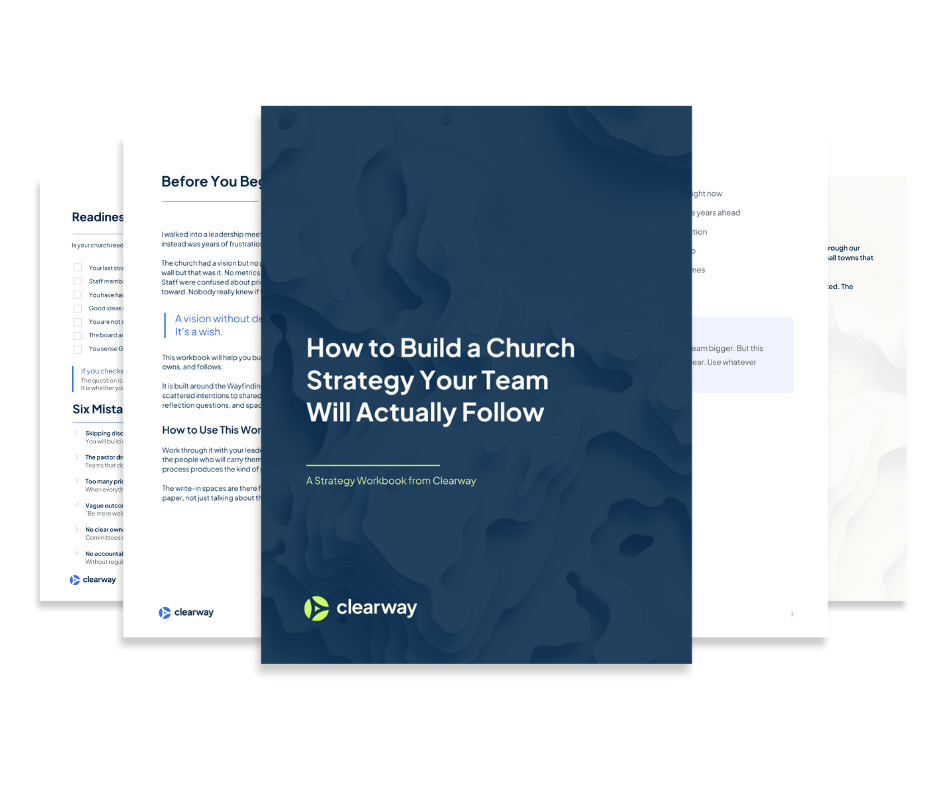
Want to start building your church's foundations on your own? Download our free guide: How to Build a Church Strategy Your Team Will Actually Follow.