

Most churches have attempted a church strategic plan at some point. A weekend retreat, a whiteboard full of ideas, a document that captured the energy of the room. Six months later that document is filed somewhere nobody can find, and the team is back to reacting week to week.
The plan didn't fail because your leaders lacked vision. It failed because it was never built to guide a decision. A strategic plan isn't a vision statement or a list of goals. It's a shared framework that tells your team what matters most right now, what you're building toward, and how to make the next call when nobody's in the room to ask.
Here's how to build that kind of plan, and how to keep it alive once you have it.
Why Most Church Strategic Plans Fail Before They Start
The trouble usually starts before the planning weekend gets scheduled. Most churches approach strategic planning as an event rather than a system. You gather the right people, generate good ideas, and produce a document. But a document isn't a plan. A plan is a set of shared commitments that shape how your team works every week.
When planning is treated as an event, three things tend to follow. The plan reflects the loudest voices in the room rather than the clearest thinking. Nothing connects the plan to weekly work, so it never touches anyone's Tuesday. And when circumstances shift, there's no built-in process for revision, so the plan quietly becomes irrelevant rather than getting revised on purpose.
The problem is that a document was produced where a system was needed.
What a Church Strategic Plan Is Actually For
A church strategic plan has one job, which is to give your team shared clarity about what matters most and why.
Clarity isn't the same as agreement. A team can agree on values and still move in six different directions. Clarity means every person on your team answers the same three questions the same way: what we're building, what our priorities are this season, and what a good decision looks like in their area.
When that clarity exists, decisions get faster and meetings get shorter. Conflict drops, because the disagreements that remain are about method rather than direction. New ideas get evaluated against a shared standard instead of personal preference or whoever asked most recently.
Before you can build any of that, your team needs to mean the same things by mission, purpose, values, and strategy. Those four get conflated constantly, and we've written about what each one actually does in detail.
Get Clear on Your Foundations Before You Plan
Nehemiah didn't start rebuilding the wall by handing out tools. He surveyed the damage at night, counted what he had to work with, and understood the full picture before he said a word to the people (Nehemiah 2:11-16). Only then did he rally the community around a plan.
Your church needs that same sequence. Before you plan, you need clarity on four things.
Mission is your localized Great Commission, the thing every church shares in some form, simple enough for a first-time guest to understand and repeat.
Purpose is narrower. It's the kingdom assignment God has given this church, in this community, in this season. Antioch was a sending church (Acts 13:1-3), while Philippi was a generous partnership church (Philippians 4:15-16). Same mission, different purpose.
Values aren't website words. They're revealed in your budget, your hiring, your calendar, and what you celebrate publicly. If nobody could reasonably disagree with one of your values, it's too generic to shape a decision.
Strategy is how you'll actually do it. It converts the first three into ministry directions, and it demands a no to good ideas that don't fit.
If those four aren't clear, skip the plan and do this work first. A plan built on unclear foundations doesn't resolve confusion, it multiplies it.
The Three Planning Horizons Every Church Needs
One of the most common mistakes I see is treating all planning as the same kind of thinking. It isn't. There are three horizons, and each one calls for a different conversation.
The 10-year Future is directional, not detailed. It answers a single question: what are we called to build? It's shaped by discernment more than data, and it gives your team a fixed point that doesn't move with the budget cycle.
The 3-year Vision is concrete enough to motivate and specific enough to evaluate. It answers what will be true in three years if you're faithful, and it lands as four to six Vision Outcomes, the priorities that guide those three years, each with one owner and a measurable outcome attached. "Increase small group participation from 30 percent to 55 percent of regular attenders" is an outcome. "Improve discipleship" is a hope.
The 1-year Outlook is where strategy becomes work. It answers what you're doing this year, in this season, with these people and this budget. It connects the long view to the next 90 days, and it's the horizon where most of your team actually lives.
Most churches plan only at the 1-year Outlook. They set annual goals without a 3-year Vision to give those goals meaning, and without a 10-year Future to give that Vision direction. The result is a team working hard and struggling to explain why. What most leaders miss is that a goal without a horizon behind it is just a task with a deadline.
The Five Stages That Take You There
Wayfinding, our strategic planning process for churches, moves through five stages over four to six months. Each one builds on the last, and skipping one is where most plans break.
Discover. Learning what's actually true about your church right now rather than what you assume is true. That means conversations with staff, board, and ministry leaders, and sometimes focus groups drawn from the congregation. Honest discovery is what keeps you from building the whole plan on an assumption nobody checked.
Dream. Exploring what might be possible and building the 10-year Future together. This is where the Five Lenses come in, looking honestly at Congregation, Community, Leadership, Operations, and Learning before anyone commits to anything. It's also where most processes rush, jumping straight from "here's what's broken" to "here's what we should do." Proverbs 16:9 holds the tension well: "In their hearts humans plan their course, but the LORD establishes their steps." We bring our best thinking and hold it loosely.
Discern. Moving from many good ideas to shared conviction. If the Dream stage did its work you'll have more possibilities than you can carry, and this stage is about telling the difference between a good idea and the right idea for this season.
Decide. Your leaders determine what you're going to do and, just as importantly, what you're not. This is where the 3-year Vision becomes four to six Vision Outcomes, the priorities that guide the next three years, each with one owner. Not ten, not fifteen. The ideas that don't make the cut go on a "not now" list so they're honored rather than quietly lost.
Define. Making each priority concrete with a measurable outcome, an owner, and a timeline. Not activities, outcomes. From there the Vision Matrix breaks the 3-year Vision into seasonal goals your team can actually act on. If your team tends to blur those two together, we've written about goals versus projects and why the distinction costs churches a year when it's missed.
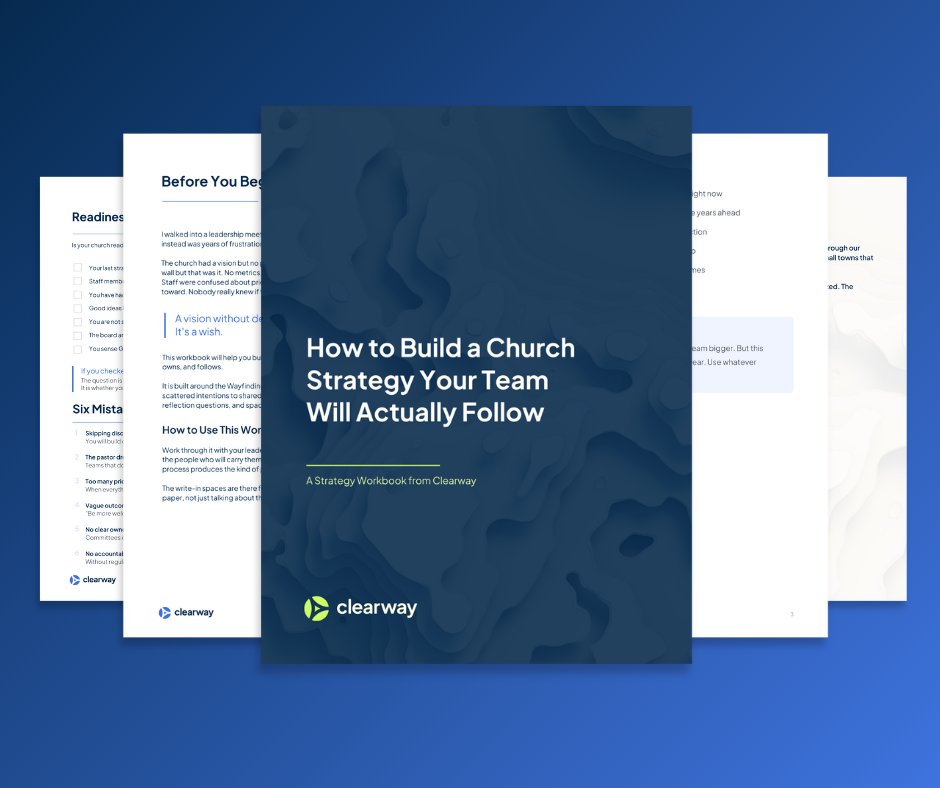
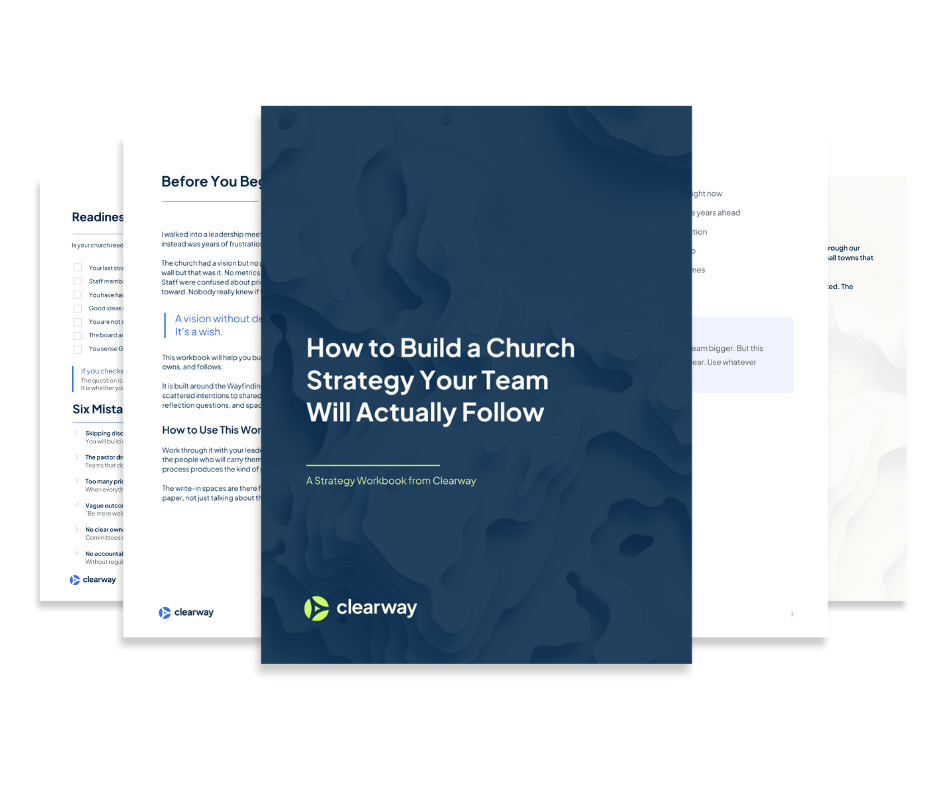
If you'd rather run this with your own team before you talk to anyone, we've put the whole process into a free church strategy workbook with the reflection questions and write-in space each stage needs.
How to Involve Your Team Without Losing Clarity
Bringing your whole team into the process and keeping the plan clear aren't opposites, but holding them together takes discipline.
The goal of involving your team in planning isn't consensus. It's ownership. The difference is that consensus means everyone agrees before anything moves, while ownership means everyone understands the plan well enough to carry it.
So gather input broadly and decide narrowly. Invite your full team to name what they're seeing, what's working, and where the friction is. Then let a smaller group, usually the senior pastor and executive leadership, make the actual calls on priorities and direction, and bring those decisions back with the reasoning attached.
Pastor David had 12 staff members who said all the right things in the planning session. When I asked each of them separately what their top priority was for the fall, I got 12 different answers. Nobody was disengaged, and every one of them had been in the room. But the session had produced agreement rather than ownership, and six weeks later that gap was showing up in twelve different directions. We rebuilt the fall around three priorities with named owners and a stated reason for each one. By Christmas he could ask any staff member the same question and hear the same answer.
When people understand why a decision got made, they can carry it even when they'd have chosen differently. The real issue is rarely disagreement about direction, it's that nobody explained the reasoning.
Turning Your Plan Into Weekly Decisions
A strategic plan that doesn't touch weekly work is a wish list with a cover page.
The connection happens through rhythm. Your team needs a regular cadence that keeps the plan visible and active: a weekly team meeting that references current priorities rather than just sharing updates, monthly one-on-ones where progress and obstacles get named out loud, a seasonal review every four months, and annual planning that reconnects the coming year to the 3-year Vision.
It also means the plan has to be reachable. Not filed in a shared drive nobody opens, but visible in the tools your team already uses and referenced in the conversations that already happen. If people have to go looking for it, they won't.
The test is simple. When someone on your team faces a decision and doesn't know which way to go, is the plan the first place they look? If it isn't, the plan isn't doing its job yet. And if you're not confident what your team would say, working through a set of church strategic planning questions together is a fast way to find out.
When to Revisit and Revise Your Plan
A good plan is stable without being rigid. It holds direction while allowing for adjustment, and each of the three horizons moves on a different clock.
The 10-year Future should rarely change. If it's shifting every year, it was never a future. It was a preference.
The 3-year Vision gets reviewed annually, because circumstances change and they should be allowed to. A campus closes, a key leader leaves, the community shifts. Your vision should be resilient enough to absorb most of that without collapsing, and honest enough to be revised when the situation genuinely calls for it.
The 1-year Outlook gets reviewed every season, roughly every four months. This is where most of the real adjustment happens, and the three questions are always the same: what did we plan to do, what did we actually do, and what needs to change for the next season?
Building those reviews into the calendar before the year starts is the single most practical thing you can do to keep a plan alive. A review that isn't scheduled is a review that doesn't happen.
Key Takeaways
- A strategic plan isn't a document. It's the shared framework your team uses to make decisions when you're not in the room.
- Plan across three horizons: a 10-year Future for direction, a 3-year Vision for outcomes, and a 1-year Outlook for this season's work.
- Gather input broadly and decide narrowly. Consensus stalls a team, ownership moves it.
- Connect the plan to weekly team meetings, monthly one-on-ones, and seasonal reviews, or it will drift no matter how good it is.
- Schedule your reviews before the year begins. The 3-year Vision annually, the 1-year Outlook every season.
Church strategic planning isn't a corporate practice borrowed and baptized. At its best it's an act of stewardship. You're responsible for people, resources, and a mission that matters, and planning is how you take that responsibility seriously.
Faithful planning holds two things at once: conviction about what God has called this church to build, and honesty about what this church can actually carry right now. It doesn't inflate the vision to impress anyone, and it doesn't shrink it to avoid risk.
So start here. Gather your leadership team and ask three questions. Can each of us state our mission, purpose, values, and strategy the same way? Do we agree on what will be true in three years if we're faithful? Do our weekly and monthly rhythms actually reference the plan we say we're following? If the answer to any of those is no, you've found your starting point.
Clearway works with church leaders to build the plan and install the rhythms that make it hold.